
SenseNova-RoboRSI-27B Full Release Outscores GPT-6-Astra, Pushing the Limits of a 27B Model with Recursive Self-Improvement
Can a robotic arm learn entirely in simulation and then grasp and place objects and stack blocks in the real world without training or fine-tuning on real robot data?
SenseTime’s newly released embodied AI model, SenseNova-RoboRSI-27B Full Release, offers new results on that question. Using the same weights learned in simulation, the model successfully stacked blocks in 9 out of 10 trials on a Piper X robotic arm and picked and placed a variety of objects in 6 out of 10 trials on a Piper robotic arm.
These results reflect improvements in the model’s ability to make decisions and execute actions autonomously. The Preview version relied primarily on a vision-language-action (VLA) model to execute tasks. The full release can decide when to invoke VLA, when to control the robotic arm directly through code, and how to adjust its strategy based on execution feedback. In the latest evaluation on the RoboDojo robotics simulation benchmark, the model achieved an average score of 34.7 points, 3.47 times the Preview version’s 10.0. At 27B parameters, it surpassed the score recorded for GPT-6-Astra by the RoboDojo team, demonstrating the potential to perform complex robotic manipulation at lower inference cost.
From Invoking VLA to Combining Execution Strategies Autonomously for Better Task Generalization
The SenseNova-RoboRSI Preview version relied primarily on predefined VLA skills for robotic manipulation. The full release expands the model’s ability to make decisions and execute actions autonomously. Across tasks, the model uses a unified toolset to decide when to invoke VLA to generate an action trajectory and when to use code to calculate a target position and control the robotic arm directly. It can also review and revise its action plans based on execution feedback.
This capability combines two approaches. VLA generates action trajectories from visual observations and is suited to complex maneuvers such as dynamically approaching objects and continuous pouring. Code as Policy uses code for spatial computation and target position planning, making it suited to tasks with explicit spatial constraints, such as stacking blocks, placing objects precisely and pressing number keys.
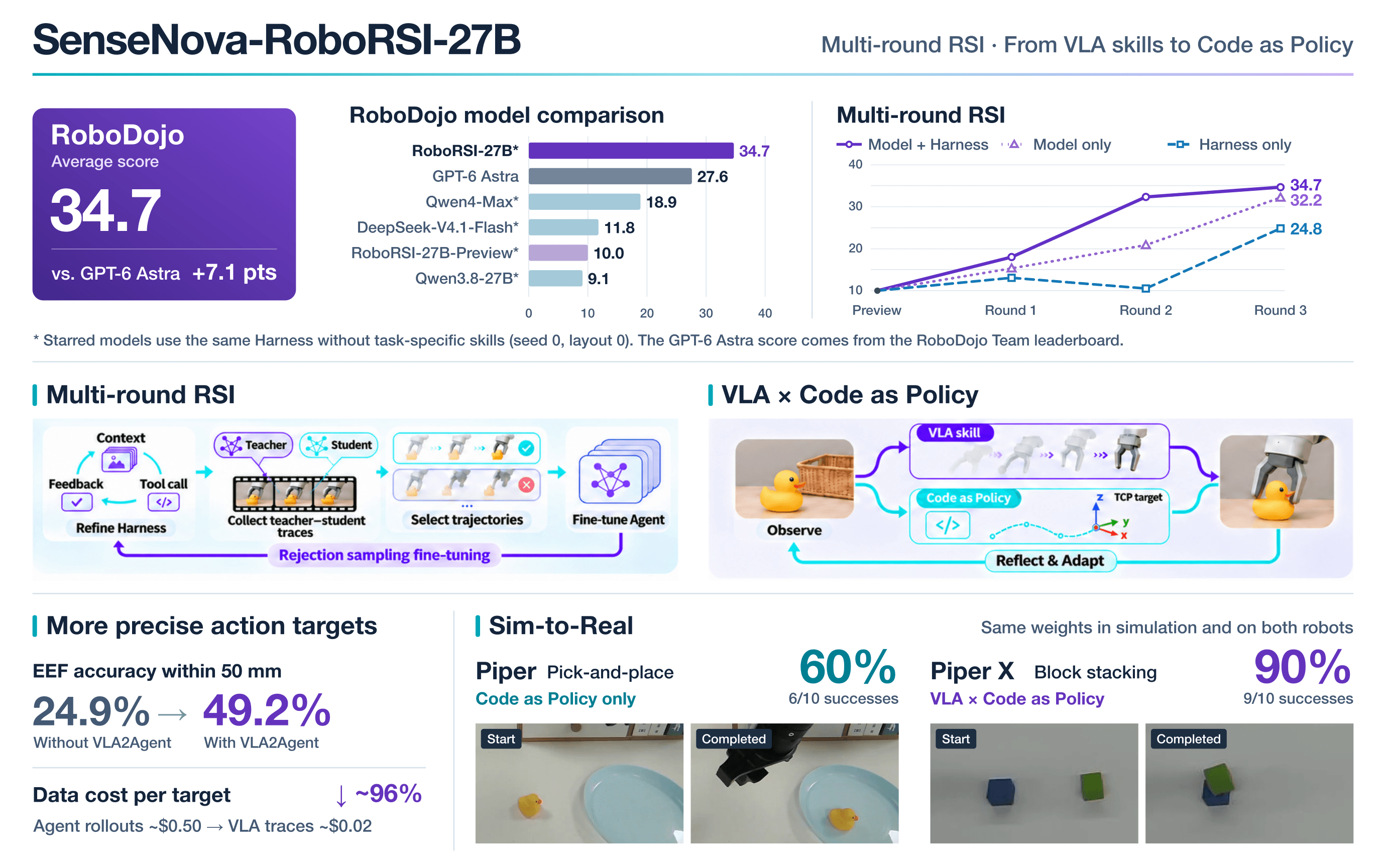
Through multiple rounds of RSI, SenseNova-RoboRSI-27B learns to invoke VLA skills and write control code, then transfers the manipulation skills learned in simulation to two physical robotic arms.
During execution, the model can switch between the two approaches as the task requires. To stack bowls, for example, it first uses VLA to grasp a bowl, then uses code to adjust the gripper position based on the bowl’s position relative to the target, allowing it to place the bowl precisely. In the full release, VLA and Code as Policy account for 41.9% and 58.1% of executed environment steps, respectively, illustrating how the model autonomously combines execution strategies.
Beyond stacking bowls, the model can use Code as Policy to perform a range of spatially constrained operations, including adjusting its grasp to an object’s orientation, pushing a T-shaped block sideways, using both arms to align two corners of a garment hem, and lowering the end effector in stages after aligning it with a hole.
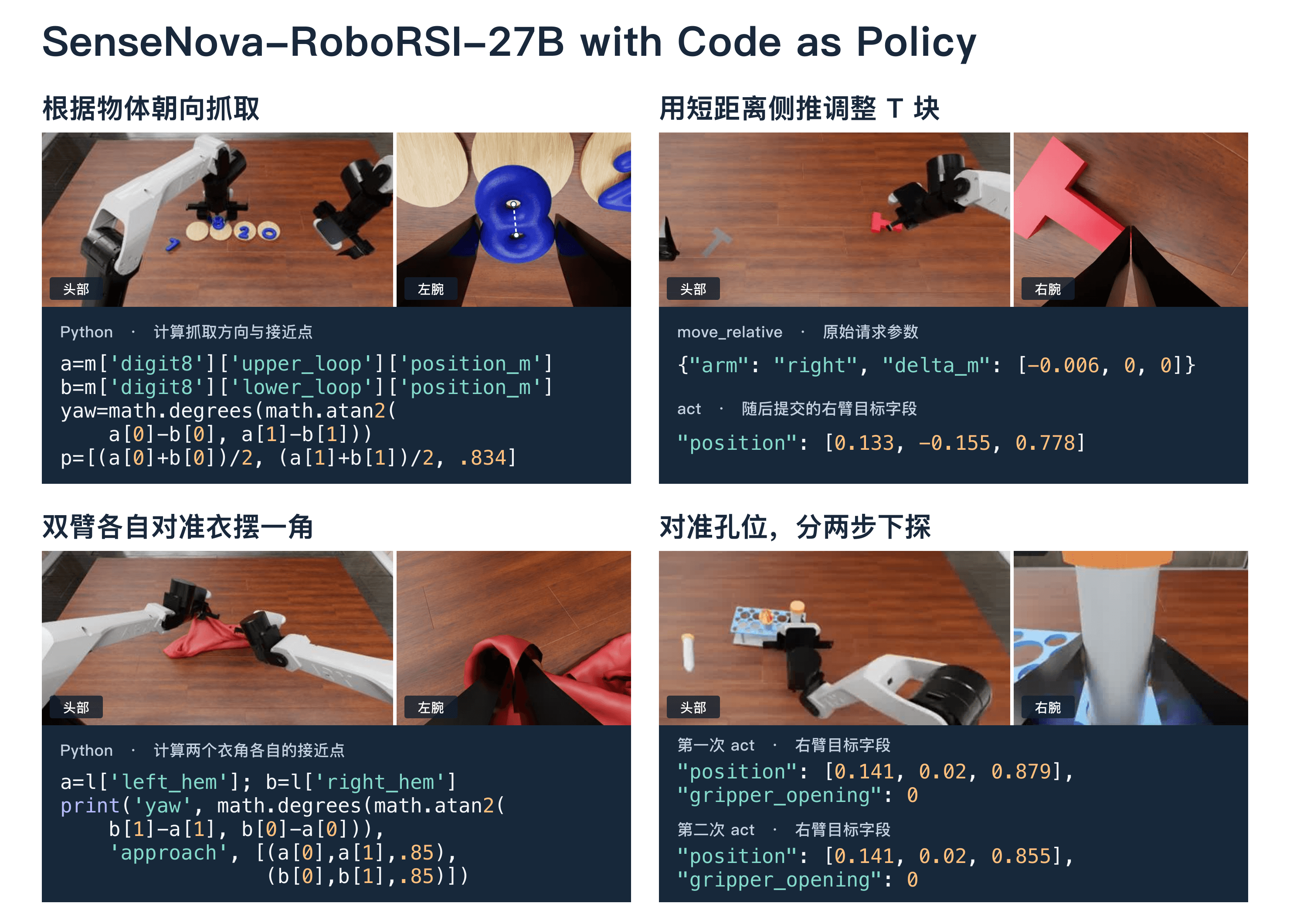
The model uses Code as Policy to control individual movements for orientation-aware grasping, lateral pushing of a T-shaped block, dual-arm alignment and precise insertion.
Multiple Rounds of RSI Improve Decision-Making and Execution
To help the model progressively learn new ways to execute tasks, the full release of SenseNova-RoboRSI-27B uses multiple rounds of Recursive Self-Improvement (RSI).
The model and its execution framework, the Harness, evolve together. A teacher model explores tasks and identifies problems, the Harness expands the available tools and execution capabilities, and the 27B model learns to use the new tools and execution methods through training.
At the start of each round, the GPT-6 Astra teacher model executes tasks with the current toolset and uses task outcomes and execution feedback to identify issues and improve the Harness, which provides the tools and execution framework. Rejection sampling then selects high-quality interaction trajectories for supervised fine-tuning of the 27B model on the updated tools and execution methods. Over multiple rounds, the model learns to review VLA trajectories, control the robot through Code as Policy and invoke spatial tools.
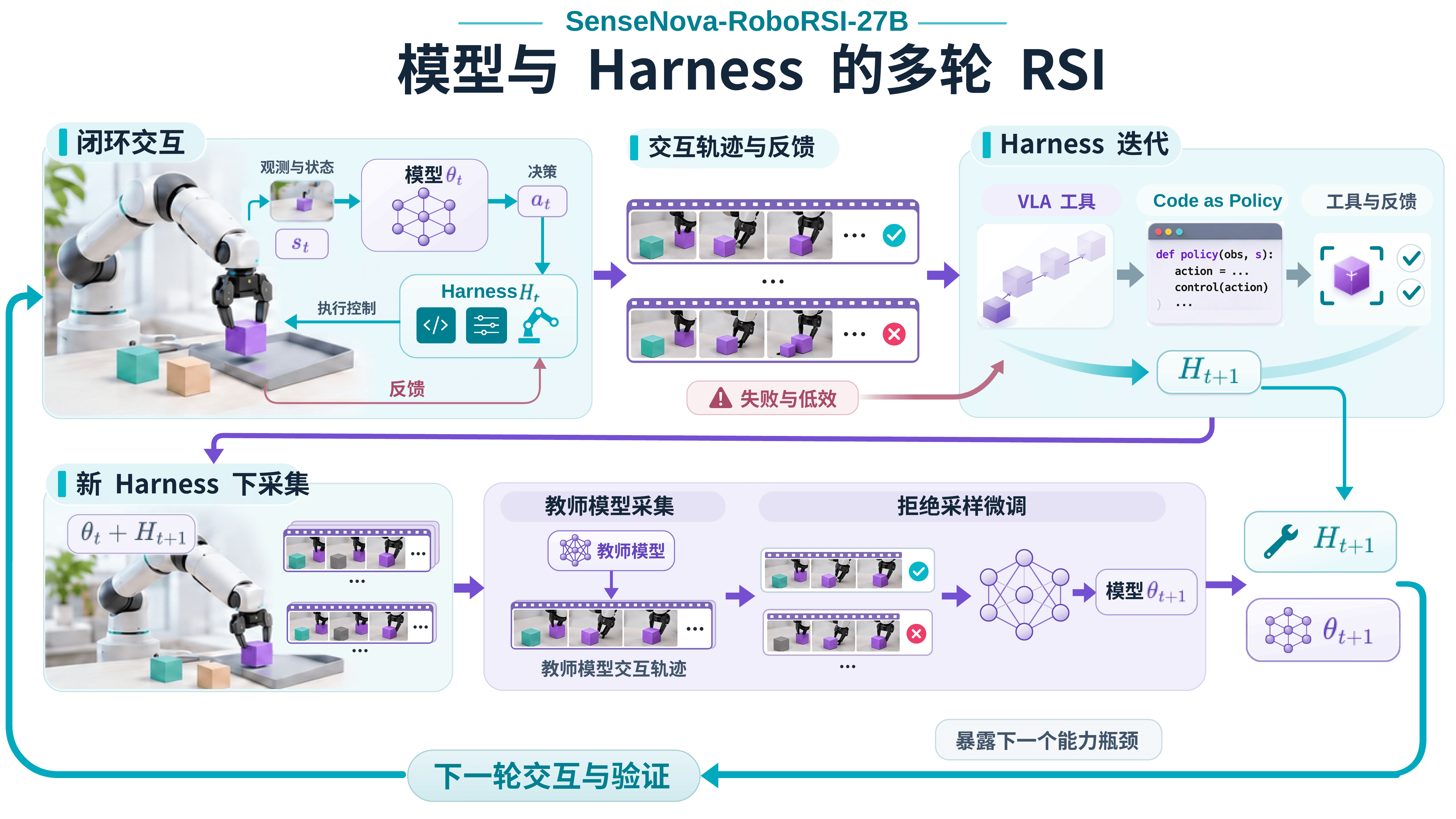
Multi-round RSI training improves execution through task interactions, feedback analysis, Harness improvements and model training.
Experiments showed that iterating on the model and the Harness together was more effective than updating either in isolation. After three rounds of joint iteration, the average RoboDojo score rose from 10.0 to 34.7.
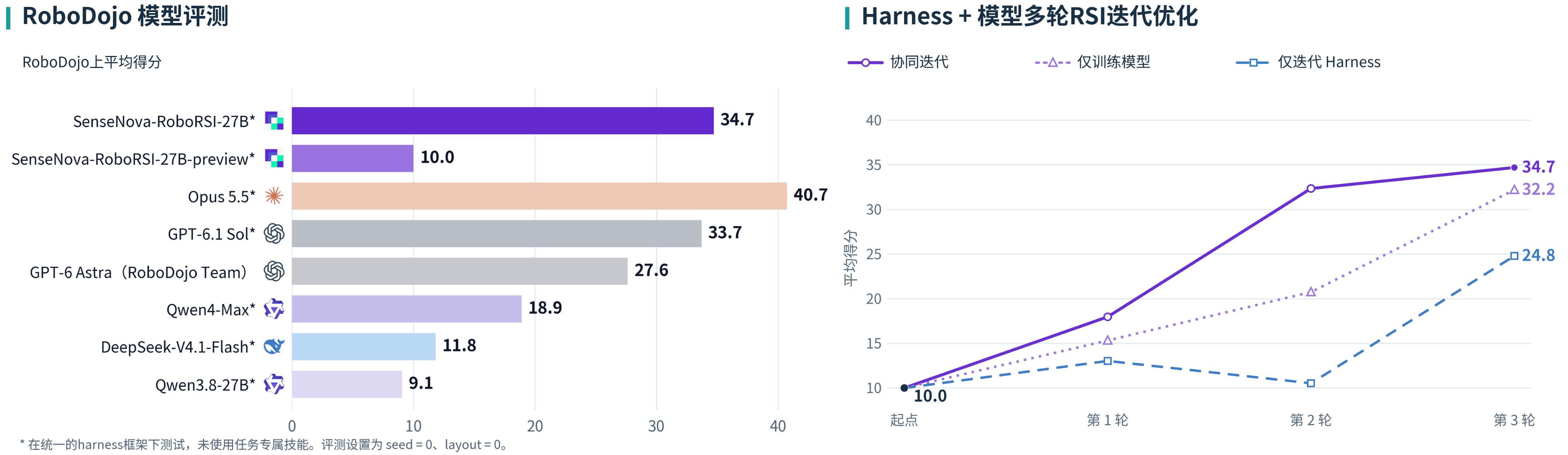
Left: RoboDojo scores across models. Right: comparison of three iteration approaches. The score rose from 10.0 to 34.7 after three rounds of joint iteration on the model and the Harness.
Alongside improvements in task-level decision-making, the team addressed the 27B model’s limitations in precise spatial localization by deriving single-turn action supervision from existing open-source VLA training data and training on it alongside long-horizon agent trajectories. Reusing existing robotic manipulation data substantially reduced the cost of constructing training data.
In experiments, the share of end-effector position predictions with errors of 5 mm or less rose from 4.3% to 15.5%, while the median position error fell from 119.7 mm to 51.6 mm, improving spatial control precision.
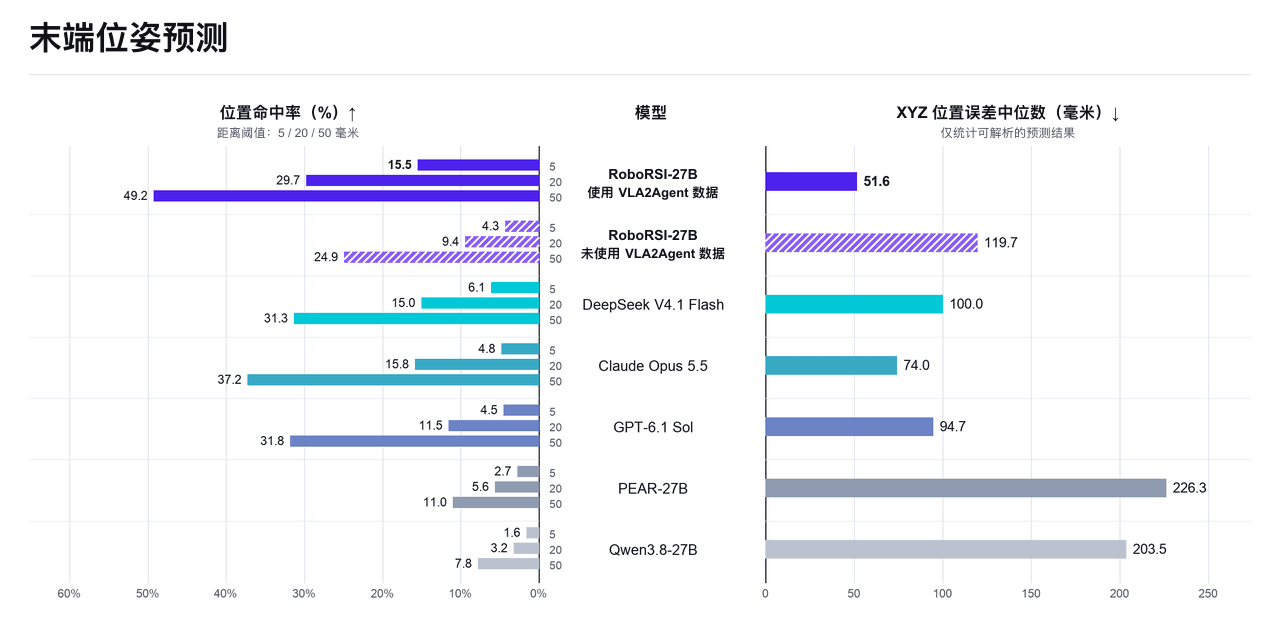
After VLA2Agent data was added, the share of end-effector position predictions with errors of 5 mm or less rose from 4.3% to 15.5%, and the median position error fell from 119.7 mm to 51.6 mm.
The Same Model Weights Transfer from Simulation to Physical Robotic Arms
Transfer from simulation to the real world is an important test of how well embodied AI models generalize. The full release of SenseNova-RoboRSI-27B uses the same model weights on two physical robotic arms, Piper X and Piper, as it does in simulation benchmarks. Deployment required adapting only the observation, state and control interfaces. No real robot data was used for training or fine-tuning.
In real-world trials, Piper X combined VLA and Code as Policy to stack blocks successfully in 9 out of 10 trials, a 90% success rate. Piper used Code as Policy to pick and place a variety of objects successfully in 6 out of 10 trials, a 60% success rate. The SenseNova-RoboRSI-27B Preview version succeeded 3 times and 2 times on the respective tasks, while the control model, which had received no robotic manipulation training, failed both tasks.
On physical robotic arms, the model can call spatial localization tools on its own, use observations from multiple viewpoints to locate a target and switch execution strategies according to the state of the task. If a trajectory proposed by VLA conflicts with the localization results, the model can reject it and generate or revise the trajectory before executing it. These results show that autonomous localization, strategy selection and error correction learned in simulation can transfer to real-world robotic manipulation.
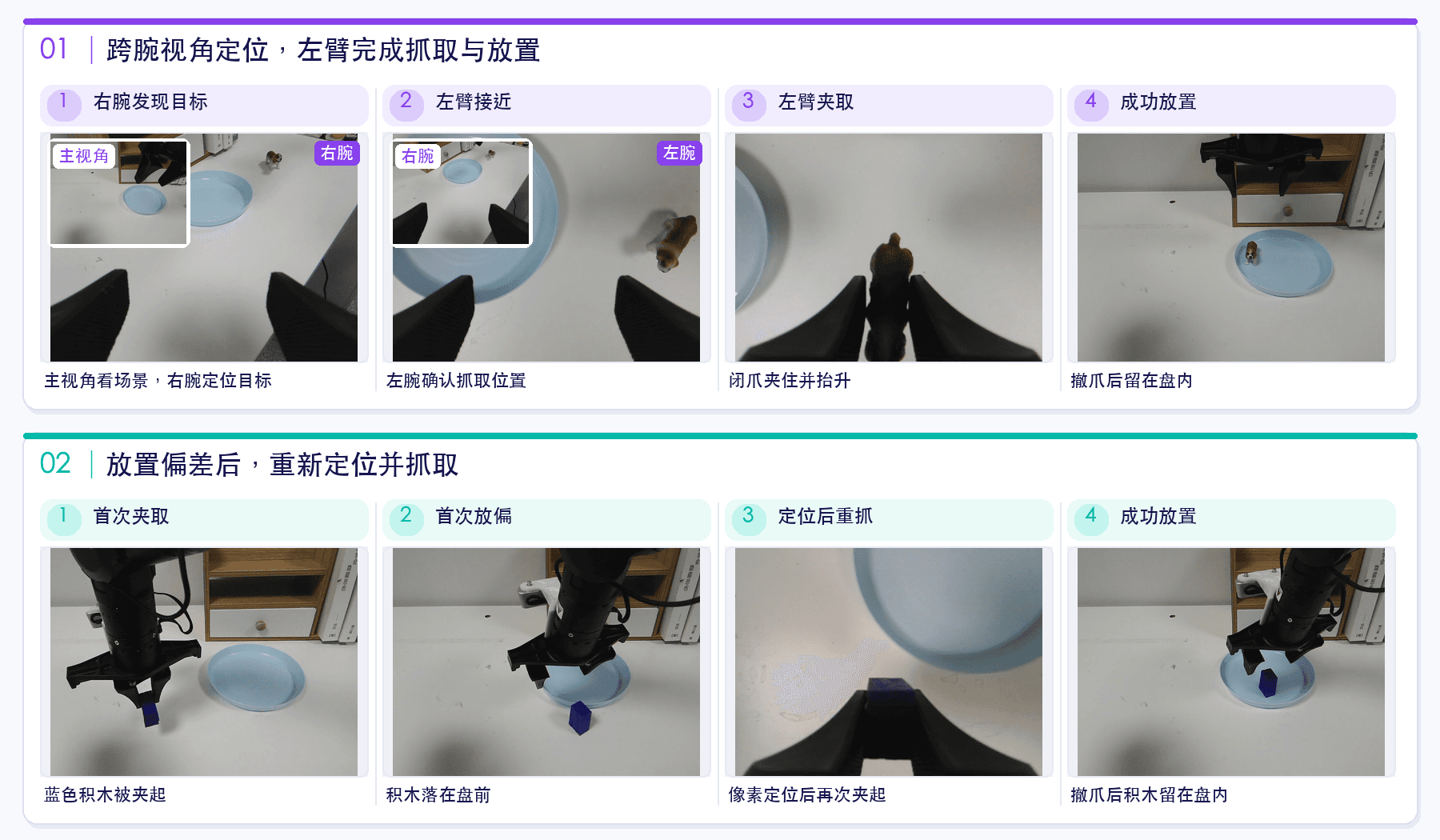
The model uses observations from multiple viewpoints to locate the target, then uses feedback during execution to locate it again and adjust its movements, correcting errors autonomously.
The full release of SenseNova-RoboRSI-27B advances general-purpose robotic agents by moving beyond predefined skills, combining execution strategies autonomously and transferring skills learned in simulation to physical robotic arms.
We will continue to explore reinforcement learning and more efficient RSI architectures for embodied AI to advance RoboRSI in three areas.
Help robots complete complex tasks more independently. To move from single actions to multistep tasks, robots must track progress toward a goal and adjust when execution goes off course, reducing the need for human intervention.
Extend learned capabilities to more real-world settings. We will test RoboRSI on more robot types and in open environments to see whether robots can use prior experience to complete tasks reliably as equipment, objects or layouts change.
Lower the cost of completing tasks. We will explore smaller open-source models that preserve manipulation capabilities, reduce per-task inference costs and shorten response times, making sustained real-world operation more economical.
We look forward to working with the open-source community so robots can independently and reliably take on more tasks that currently require continuous human supervision.
Open-source model resources:
Hugging Face: https://huggingface.co/sensenova/SenseNova-RoboRSI-27B
Technical blog: https://huggingface.co/blog/sensenova/roborsi