
Yang Fan of SenseTime: The Token Economy Must Shift from Consumption-Based Metering to Outcome Value
Recently, the 2nd Guangdong AI Application Partnership Conference was held in Guangzhou. The conference thoroughly implemented the guiding principles of General Secretary Xi Jinping's important speech at the opening ceremony of the 2026 World Artificial Intelligence Conference and High-Level Meeting on Global AI Governance. Under the theme "Connecting Intelligence Across Industries and Empowering Every Sector," it brought together stakeholders from industry, academia, research, finance and government to further accelerate the high-level application of artificial intelligence in Guangdong across all regions, at all times and throughout all industries, with Meng Fanli, Deputy Secretary of the CPC Guangdong Provincial Committee and Governor of Guangdong Province, attending the conference and delivering remarks.
As a representative of China's leading specialized companies in the artificial intelligence sector, SenseTime was invited to attend, and Yang Fan, Co-Founder of SenseTime and President of SenseCore Business Group, delivered a keynote speech titled The Next Step for Tokens: Trends in the Implementation of Artificial Intelligence 2.0. He shared his perspectives on the implementation of AI 2.0, focusing on the token economy, the value of data in real-world scenarios, and the development of an AI infrastructure ecosystem.
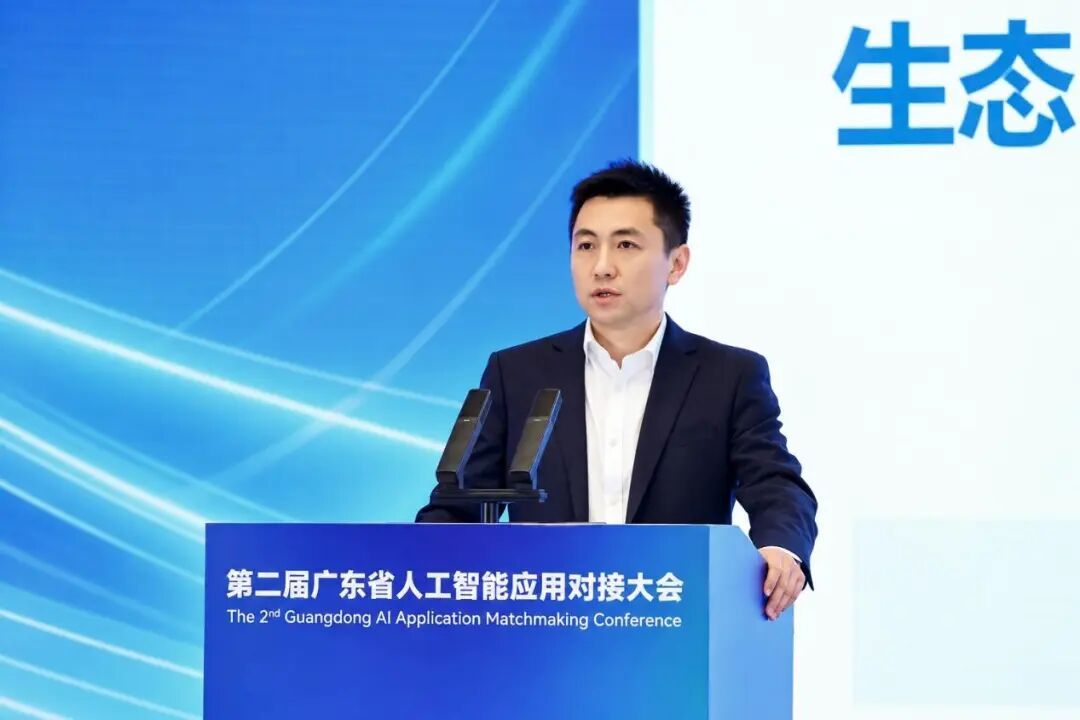
Yang Fan said that the era of AI 2.0 is ushering in new development trends: the token economy needs to become more closely tied to application outcomes and business value; the long-term competitiveness of AI applications will increasingly come from real-world scenarios and accumulated data; and the competitiveness of AI infrastructure is also shifting from simply supplying computing power toward collaboration across the entire industry chain.
QUOTE
'The token economy should gradually move from "paying for model consumption" to "paying for verifiable task outcomes."'
—Yang Fan, Co-Founder of SenseTime and President of SenseCore Business Group
01
TOKEN ECONOMY
The Token Economy: From "Measurability" to "Verifiable Outcomes"
Regarding the token economy, which has attracted considerable attention, Yang Fan noted that while tokens can be measured, they still face challenges before becoming mature, standardized tradable commodities. "The value of different quantities of one million tokens can vary enormously."
In his view, tokens are more like intermediate raw materials in the AI production process than finished products. What businesses truly care about are practical questions such as how much they have spent, what problems have been solved, and whether the investment is worthwhile.
Therefore, the token economy still needs to address issues such as "non-fungible value, unpredictable delivery and unverifiable quality". Yang Fan noted that for token factories or the token economy to achieve long-term vitality, they must establish closer links with real-world applications and end results, gradually moving from "paying for model consumption" to "paying for verifiable task outcomes". In his view, the RaaS (Result as a Service) model proposed by the market in the past may point to the direction of the token economy's further evolution.
02
AI INFRASTRUCTURE
AI Infrastructure: Scale Sets the Floor, While Responsiveness and Iteration Set the Ceiling
Yang Fan explained that, compared with traditional infrastructure, the biggest difference with AI infrastructure is that capital-intensive investment cycles are relatively long, while the cycles for downstream models and applications are extremely short. Once traditional infrastructure investment is completed, downstream applications often take several years or even longer to show significant changes. By contrast, once AI infrastructure is in place, models and applications may undergo multiple rounds of change within just a few months.
Not only that, the pace of AI innovation has approached or even exceeded the limits of traditional enterprises' organizational responsiveness.
In response, Yang Fan stated clearly: Computing capacity determines the floor of the AI infrastructure business, but responsiveness and the ability to iterate ultimately determine its ceiling. "AI infrastructure companies need to build AI-native organizations capable of self-iteration and self-optimization to remain more competitive in a rapidly changing market." This responsiveness and ability to iterate must also extend further across the industry chain, accelerating collaborative innovation in technology, resources and applications.
Against this backdrop, SenseCore clearly positions itself as Neo AI Cloud for Chinese Ecosystem, using the AI-native cloud platform SenseCore to drive end-to-end integration of resources spanning energy, computing power, models and applications. It connects downward to electricity, energy storage, AIDC and heterogeneous hardware, and upward to models and applications. Through unified resource management, intelligent scheduling and Token services, it transforms underlying resources into AI services that can be continuously optimized.
In terms of ecosystem development, SenseCore this year joined forces with nearly 20 ecosystem partners to launch the domestic AI infrastructure ecosystem co-development "Galaxy Initiative", working together on such goals as establishing one Token operations center, five domestic intelligent computing clusters with more than 10,000 GPUs each, 10 core technology areas and empowerment for 200 AI startups, while building the full chain from foundational technologies to commercial-scale deployment.
SenseCore currently handles a daily average Token service volume of approximately 4.5 trillion, and its total Token volume for 2026 is expected to be approximately 25 times higher than at the beginning of the year. "While accelerating the development of its own capabilities, SenseCore also hopes to bring this infrastructure capability further into industry applications," Yang Fan said.
As a company that grew out of the Greater Bay Area, SenseTime also regards Guangdong as an important region for putting its AI services business into practice. SenseCore and its partners are currently developing intelligent computing centers in Qianhai and Hetao, two core areas, providing computing support for key colleges and industries across the Greater Bay Area. It is also deepening cooperation with Shantou to empower the toy industry with AI and support the implementation of the local "Hundreds and Thousands Project." Building on this foundation, SenseCore will further address the needs of Guangdong's industries, identify more high-quality cities and partners, and jointly develop a next-generation Token demonstration factory in the Greater Bay Area, bringing AI capabilities deeper into industries and industry services, accelerating the application of AI across sectors, and supporting the deep integration of artificial intelligence with the real economy in Guangdong.